

Childhood and Early Years in Gracie Jiu Jitsu
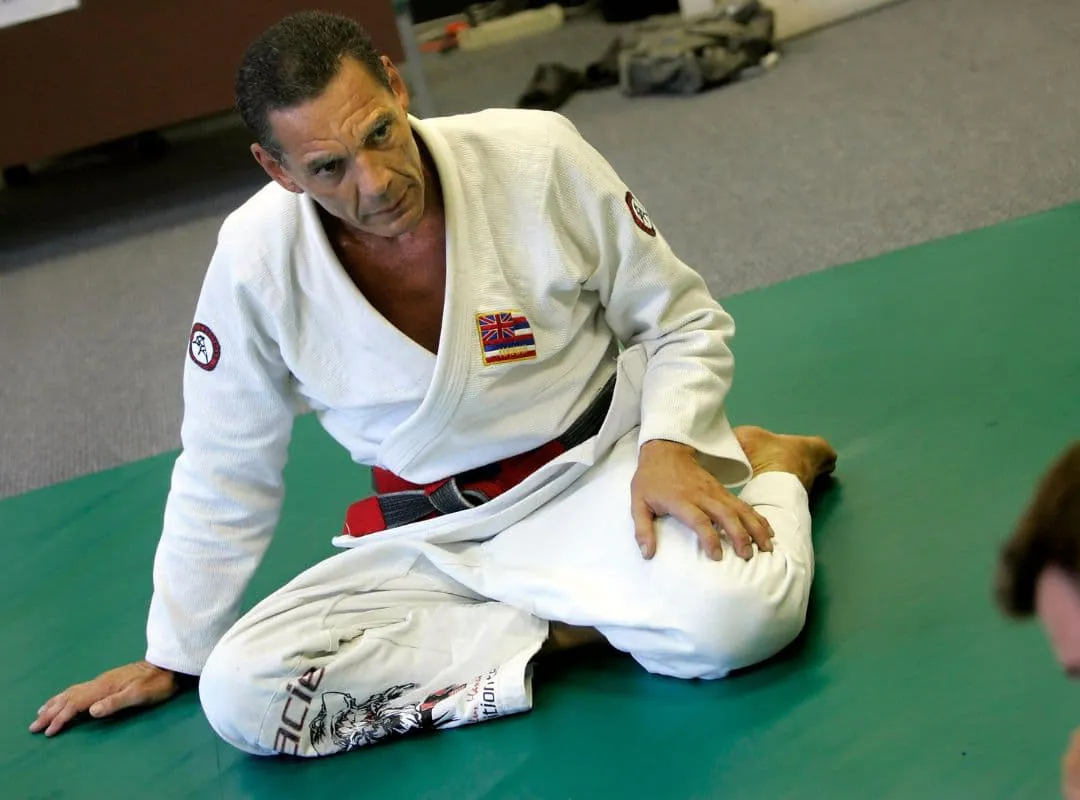
Carlson Gracie was born on August 13, 1932, in Rio de Janeiro. As the eldest son of Carlos Gracie, co-founder of Gracie Jiu Jitsu, he grew up in the very center of the family that shaped Brazilian Jiu Jitsu in Brazil and later spread it far beyond its borders. His father Carlos, together with his brother Hélio Gracie, had developed an independent system based on the teachings of the Japanese Judoka Mitsuyo Maeda. For young Carlson, Gracie Jiu Jitsu was therefore not a sport he discovered at some point. It was part of his everyday life from a very early age. He trained under his father Carlos and his uncle Hélio when he was still a small child.
At the age of 15, Carlson left school to dedicate himself fully to Brazilian Jiu Jitsu. Just two years later, at 17, he won the Campeonato Carioca de Jiu Jitsu, the first official state championship in Rio de Janeiro. His talent was visible early on, and his name soon became visible too.
Rising as the Family’s Active Competitor
In the 1950s, Carlson Gracie took on a central role as the active competitor of the family. His most well-known appearance took place on July 21, 1956, at the Maracanãzinho in Rio de Janeiro. The arena was sold out with 40,000 spectators, newspapers dedicated front pages to the event, and television broadcast it live. That evening, Carlson faced Waldemar Santana, one of the most well-known Vale Tudo fighters in Brazil at the time, and delivered a strong performance. Overnight, the young Gracie became a national figure, and Gracie Jiu Jitsu was once again in the public spotlight.
In the years that followed, he competed many times against representatives of various disciplines, from Capoeira and Luta Livre to wrestling and boxing. For nearly two decades, Carlson was the active competitive face of the Gracie family and one of the most recognized names in Brazilian Jiu Jitsu in Brazil.
His Contribution to the Development of Brazilian Jiu Jitsu
In addition to Gracie Jiu Jitsu, Carlson trained intensively in Judo and wrestling. His style was athletic, with strong pressure from the top, and this approach gave him clear advantages both in competition and in self-defense. In open matches against fighters from a wide range of disciplines, he showed year after year what the family’s system could achieve. These appearances gave Gracie Jiu Jitsu broad credibility in Brazil and beyond, a credibility from which many modern academies still benefit today.
His Own Academy in Copacabana
In the mid-1960s, Carlson Gracie opened his own academy in Copacabana, on Rua Figueiredo Magalhães. Over the next four decades, this address became one of the most important destinations for BJJ in Brazil.
Carlson wanted Brazilian Jiu Jitsu to be accessible beyond the small circles of the city. He encouraged group classes and welcomed young people from modest backgrounds to train. Those who showed talent and competed for his team were able to train for free. Within just a few years, an unusually large number of strong athletes were on the mats at the academy at the same time, and the school quickly became a meeting point for ambitious competitors.
The Competition Team and Its Influence on BJJ
From the 1970s onwards, the Carlson Gracie Academy became one of the most successful competition teams in Brazilian Jiu Jitsu. In the 1980s and early 1990s, it was considered one of the strongest schools in Brazil. From its ranks came athletes who continue to shape BJJ and modern MMA today.
Ricardo De La Riva, as a young student in the 1980s, developed his own guard position, which is now part of the standard vocabulary of every modern BJJ school as the De La Riva Guard. Ricardo Liborio won the first BJJ World Championship in the super heavyweight division in 1996. Murilo Bustamante became UFC Middleweight Champion in 2002. André Pederneiras later founded Nova União, one of the most successful BJJ academies in the world. Vitor Belfort started his career under Carlson and became one of the most well-known names in UFC history.
Throughout his career, Carlson Gracie brought more than 100 students to the black belt in Brazilian Jiu Jitsu. From his lineage emerged academies that today rank among the most influential worldwide, including Brazilian Top Team, American Top Team and Nova União.
Carlson and the Early Days of MMA
Long before the term MMA was even used, Carlson Gracie was already an experienced Vale Tudo fighter. When Rorion Gracie founded the first Ultimate Fighting Championship in the United States in 1993 and Royce Gracie shaped the tournament, Carlson had spent years building a school full of battle-tested athletes in Rio. His student Murilo Bustamante made his UFC debut in 2000 and won the middleweight title two years later. André Pederneiras built Nova União into an academy that produced UFC Champions such as José Aldo.
Even in his later years, Carlson remained close to competition. During the first season of the UFC reality show The Ultimate Fighter in 2005, he stood as cornerman behind the American fighter Stephan Bonnar. The final between Bonnar and Forrest Griffin is still considered one of the most important fights in UFC history and marked the breakthrough of the sport in North America.
Death and Legacy
Carlson Gracie passed away on February 1, 2006, in Chicago at the age of 73. At the time of his death, he held the red belt in the 9th degree and the title of Grandmaster in Brazilian Jiu Jitsu.
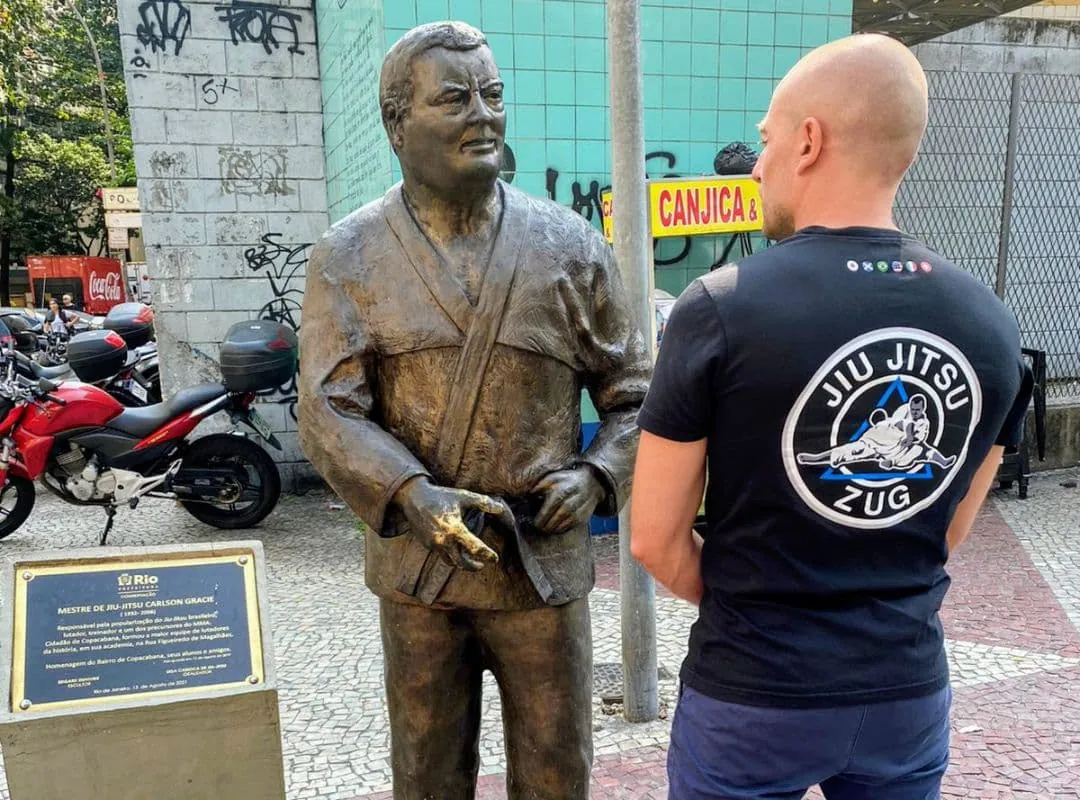
On August 12, 2019, a bronze statue was unveiled in his honor at Praça Shimon Peres in Copacabana, at the corner of Rua Figueiredo de Magalhães and Tonelero, very close to his original academy. The statue was created by the Brazilian sculptor Edgar Duvivier and was financed by students and friends of Carlson.
Conclusion
Carlson Gracie is among the most important figures in the history of Brazilian Jiu Jitsu. As an active competitor, he carried his family’s name for many years. As an instructor and academy founder, he shaped the way Gracie Jiu Jitsu is taught and passed on. His open approach to teaching, his sense for talent, and his clear focus on competition laid the foundation for many of the most successful academies in modern BJJ and MMA.